

Key Takeaways
- A drip is almost always a cheap worn part — a washer, an O-ring, or a corroded valve seat.
- The fix depends on your faucet type — compression, cartridge, ball, and disc faucets fail in different ways.
- Many leaks are a doable DIY — shut off the water, then tighten or replace the worn part.
- It is worth fixing fast — a steady drip wastes thousands of gallons a year, so call for faucet repair if the DIY does not hold.
A dripping faucet is almost always a small, inexpensive part that has worn out — a rubber washer, an O-ring, or a corroded valve seat. The drip looks minor, but it wastes a surprising amount of water and only gets worse, so it is worth fixing sooner rather than later. The right fix depends on which part failed and what type of faucet you have.
Here is what makes a faucet drip, how to fix it yourself, and when it is time to call a plumber.
What a Dripping Faucet Really Costs
It is easy to tune out a drip, but it adds up in ways worth knowing. A faucet dripping about once per second wastes more than 3,000 gallons of water a year — water you are paying for and never use. Beyond the bill, the constant moisture leaves mineral stains and rust spots in the sink, and the underlying wear only gets worse, so a slow drip today becomes a steady stream and a pricier repair later. Fixing it early is the cheap, easy path.
Why Is Your Faucet Dripping?
Track the drip to one of these causes and the fix becomes clear.
A Worn-Out Washer
The most common culprit, especially in older faucets. Every time you turn the tap, the rubber washer presses against the valve seat, and over years of friction it wears down, hardens, or tears until it can no longer seal. Replacing it is cheap and usually stops the drip.
A Damaged O-Ring
The O-ring is a small rubber ring that seals the faucet handle. As it ages it dries out, loosens, or cracks, which often shows up as a drip or leak right around the base of the handle rather than the spout.
A Corroded Valve Seat
The valve seat connects the faucet to the spout, and minerals and sediment in the water build up and corrode it over time. A corroded seat will not seal against the washer, so the faucet keeps dripping even after a new washer goes in. It needs to be cleaned or replaced.
Improperly Installed Parts
Sometimes the issue is not wear but a part that was never seated right — a washer the wrong size, a loosely tightened nut, or a fitting installed incorrectly. A leak that started right after a repair often points here.
Know Your Faucet Type
There are four common types, and they fail differently. Compression faucets (separate hot and cold handles) rely on washers and are the most drip-prone. Cartridge, ball, and disc faucets are washerless and usually leak from a worn cartridge, O-rings, or seals instead. Knowing which you have tells you what part to look at — and is why a one-size repair does not exist.
How to Fix a Leaky Faucet
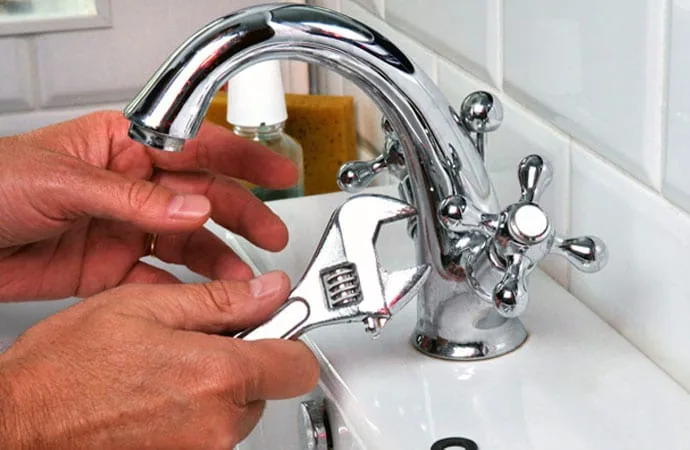
For a confident DIYer, many faucet drips are a manageable job. Before anything else, turn off the water at the shutoff valves under the sink and open the tap to release pressure, then plug the drain so small parts cannot fall in.
From there, the fix follows the cause. If the leak is around the handle and the packing nut is simply loose, snug it up — sometimes that is all it takes. If a compression faucet has a worn washer, remove the handle and stem and swap in a matching replacement. If the O-rings are dried or cracked, replace them with the exact same size, since an O-ring that is even slightly off will leak again. And if the valve seat is corroded, clean it with a seat wrench or have it replaced, because a new washer will not seal against a pitted seat.
Reassemble in the reverse order, turn the water back on slowly, and test. A good habit is to lay the parts out in the order you removed them so reassembly is straightforward, and to take a photo before you start.
When to Call a Professional
Plenty of drips are DIY-friendly, but call a plumber when the leak continues after you have replaced the obvious parts, when you cannot pin down where it is coming from, when the valve seat or cartridge is seized or corroded badly, or when an older faucet is simply worn out and due for replacement. A pro can also tell you when a repair makes sense versus a new fixture. There is no shame in it — chasing a stubborn leak yourself can cost more in wasted water and a damaged faucet than the repair would.
Stop the Drip With Degree of Comfort
If the drip will not quit or you would rather not take the faucet apart, Degree of Comfort can fix or replace it fast. We handle faucet repair and replacement and all other plumbing needs for homeowners across Cincinnati and the surrounding Tri-State, including Northern Kentucky and Southeast Indiana, and we are family-owned, licensed and insured, with upfront, flat-rate pricing and a satisfaction guarantee.
Tired of the drip? Call (513) 586-5107, ask about faucet repair, or request an estimate and let our team handle it.
Frequently Asked Questions
Let Degree of Comfort Handle It
Our licensed technicians serve Cincinnati and surrounding areas. Same-day service available.
Call (513) 586-5107