Structural Drying in Paddock Hills, Cincinnati, OH
Structural Drying in Paddock Hills
Structural drying in Paddock Hills often saves a hardwood floor by working both faces at once. Near Paddock Road and the Norwood Lateral, mats draw moisture up through the boards while air movers in the basement dry the subfloor and joists from below.
Local Structural Drying Pros Who Know Paddock Hills
Paddock Hills (ZIP 45229) is a small, well-kept north-side pocket near Paddock Road and the Norwood Lateral, its early- and mid-1900s homes laid with original solid hardwood over the main floor. Solid hardwood releases water slowly and holds it deep in the board while the top feels dry, and a floor left in that state is the one that cups, crowns, and lifts at the seams a season later.
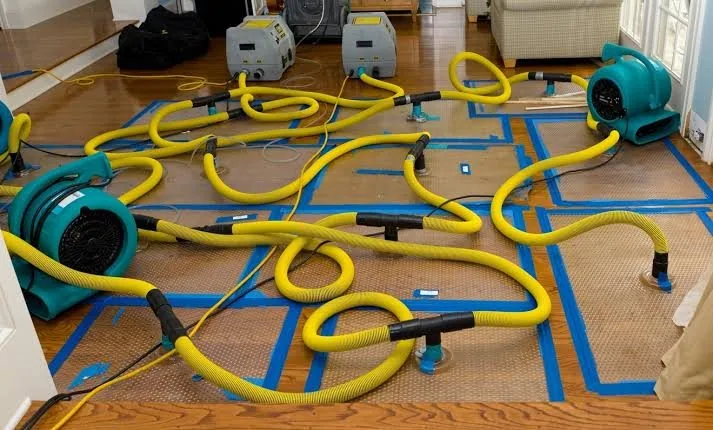
Where there is a basement under the floor we dry it from both faces: mats sealed to the boards drawing moisture up through the top, and air movers below pushing dry air across the underside of the subfloor and the joists. Dehumidifiers take the moisture out of both spaces. We meter the top of the boards and the underside separately, because the gap between the two tells us how far there is to go, and hold until both reach the standard set by wood in a dry room. A shallow clean puddle wiped off a sealed floor within the hour has nothing holding it and needs none of this.
What the Job Covers
Mapping how far the water travelled with meters and, where it helps, thermal imaging. Opening sealed wall cavities where they cannot dry on their own, usually with small controlled openings rather than replacing a whole wall. Setting air movers to lift moisture out of materials and dehumidifiers to pull it out of the air before it settles back in.
Then the part that matters: the same readings from the same points in your Paddock Hills home, every day, compared against a dry standard taken from an unaffected part of the same house in the same material.
Documented for Your Insurer
You get the daily reading log. Adjusters expect to see drying documented, and having the numbers prevents most disputes about whether the work was needed or whether it was finished. Whether the underlying water event is covered remains your insurer’s decision.
What Still Holds Water in a Paddock Hills Home
In Paddock Hills' early- and mid-1900s homes, the drying work usually follows:
- Subfloor and floor joists under carpet or hardwood
- The bottom of drywall sheets, where water wicks upward well above the visible line
- Wall cavities and the insulation inside them
- Framing and sill plates along exterior walls
Happy Homeowners
Why Homeowners in Paddock Hills Choose Degree of Comfort
Five Paws Across the Board.
Family owned since 1993, 33 years of experience
Hear more from our customers





Water out but still damp in Paddock Hills? Call to get equipment in
Call NowDrying the Structure, Not the Surface
Household fans move air across a surface. That dries the surface and leaves the water inside the material, which is why a room can feel dry and still smell two months later. Restoration air movers are shaped to lift moisture out of the material itself, and they only work paired with dehumidifiers — otherwise you are moving water from the floor into the air and back into the walls of your Paddock Hills home.
How We Know When It Is Actually Dry
We take readings from the same points daily and compare them against a dry standard from an unaffected part of the same house, in the same material. When the affected areas reach that baseline and hold it, the structure is dry. That comparison is the whole method — a moisture reading on its own tells you very little, because what counts as dry depends on the material and the weather that week.
Less Gets Torn Out Than You Expect
Drywall that was wet but not contaminated can frequently be dried in place rather than cut out. What generally cannot be saved is carpet pad, saturated insulation, and anything touched by contaminated water. We would rather dry material than bill you to replace it, and in older Paddock Hills houses that is often the difference between keeping original finishes and losing them.
When You Do Not Need Us
Clean water on a hard, sealed floor that you wiped up within the hour does not need structural drying. Nothing porous took it on, so there is nothing left to dry — open a window and move on. A damp patch that has been there for years in a basement that has always been humid is also not a drying job. That is an ongoing moisture source, groundwater or a failed gutter or poor grading, and running equipment on it just runs your meter. Find the source first, and if it is not plumbing we will tell you on the phone rather than send a truck.
Why Paddock Hills Homeowners Call Us
Drying equipment goes in on our first visit to your Paddock Hills home. We take meter readings in the same spots every day, so you see numbers instead of a guess, and that log is what your adjuster asks for.
Degree of Comfort in Paddock Hills


Structural Drying FAQs for Paddock Hills
Usually three to five days, and often the longer end for solid wood, because hardwood gives its moisture up slowly and evenly, which is what lets us save it. Drying from both faces where there is a basement speeds it up, but the boards still set the pace, not the calendar. We meter the top and the underside daily and pull the mats when both hit the dry standard, not on a fixed schedule. Stopping early because the surface feels dry is what leaves a floor to cup weeks later.
Most homes run three to five days with equipment in place. What changes it is how much water there was, which materials it soaked into, how much of it we could extract first, and the humidity outside. Hardwood and plaster take longer than carpet and drywall. We read it daily and pull the equipment when the numbers hit target, not on a fixed schedule.
Household fans move air across a surface, which dries the surface and leaves the water inside the material. Restoration air movers are shaped to lift moisture out of the material itself, and they only work paired with dehumidifiers — otherwise you are moving water from the floor into the air and back into the walls. Fans alone are why a room can feel dry and still smell two months later.
Yes, continuously. Drying stops when the equipment stops, and moisture redistributes back through the material overnight if you switch it off. It is noisy, and it does add to your electricity bill for those days. Turning it off to sleep is the single most common reason a job takes twice as long.
We take moisture readings from the same points daily and compare them against a dry standard from an unaffected part of the same house, using the same material. When the affected areas reach that baseline and hold it, the structure is dry. That comparison is why a reading on its own does not tell you much.
Less often than people expect. Drywall that was wet but not contaminated can frequently be dried in place. What generally cannot be saved is carpet pad, saturated insulation, and anything that was touched by contaminated water. We would rather dry material than bill you to replace it.
Where the water event itself is covered, drying normally is too, and it is the part adjusters most expect to see documented. The daily reading log we produce is what supports that. Coverage of the underlying event is still your insurer’s decision.
It depends entirely on what the water touched. Clean water on a sealed floor wiped up within the hour needs nothing. Water that reached carpet, drywall, framing, or subfloor is a different matter — that material stays wet long after the room looks normal, and mold can begin establishing in damp material within roughly 24 to 48 hours. A meter reading settles the question in a couple of minutes.

Need Structural Drying in Paddock Hills?
Call now for fast, licensed service in Paddock Hills, Cincinnati, OH, or request an estimate.
Call (513) 586-5107Need Structural Drying in Paddock Hills? Tell us what’s going on.
(513) 586-5107Call · Mon–Sun: 8am–8pm
Step 1 of 2